Abulafia
Foucault's PendulumAbulafia, Jacopo Belbo’s word processor, begins as a tool for private play and becomes the machine through which Casaubon enters Belbo’s inner life. It stores experiments in language, fragments of fiction, and a final record of events; it can also rearrange information on a scale that makes combinatorial speculation seem almost limitless. That double function is decisive: Abulafia makes invention feel like discovery, yet preserves the traces through which Casaubon can recognize invention as a human act.
A private machine and a second adolescence
Belbo takes Abulafia away from the office when he leaves for what he tells Gudrun are family reasons, explaining that he has set up the word processor at home to finish work. The unexplained removal of both machine and printer unsettles Casaubon, who has returned to find Diotallevi still in hospital and Lia and the baby away. The machine’s absence becomes an early sign that Belbo is withdrawing into a private space whose contents Casaubon cannot yet reach.
One of the few pages Belbo leaves printed is an early file called “Abu.” It reveals the machine’s original role as a private reply to critics, a sophomoric joke that nonetheless exposes the intensity of Belbo’s combinatorial curiosity. Belbo had described himself as an intelligent spectator rather than a protagonist: he preferred rewriting other people’s books to writing without a serious motive. At the keyboard, however, he could experiment without the fear of being judged. He did not consider this genuine creativity or writing, but an electronic exercise, a kind of second adolescence in which his usual pessimism and nervousness briefly loosened their hold.
The appeal lies partly in the machine’s unusual relation to memory. Its memory is inorganic, objective, obedient, and nonmoral: it can retain material without carrying the burdens of human recollection. Casaubon and Diotallevi discuss the difficulty of deliberately forgetting, contrasting the effort of recovering lost time with the impossibility of choosing to mislay it. Abulafia, by contrast, can make precise local erasures—temporary amnesias and painless aphasias. In one instance, Casaubon deletes a sentence he has written and regrets, watching the words vanish. The machine does not simply preserve thought; it also gives its user a controlled means of disowning it.
Password, archive, and recovered voice
Belbo is possessive about Abulafia’s secrets and has mentioned that it is protected by a password. When Casaubon loads the machine, its screen asks, “Do you have the password?” The question is phrased politely rather than as a command, a small sign of Belbo’s manner embedded in the interface. Without the right word, the machine remains silent, presenting itself as a locked repository whose contents are physically present but inaccessible.
In a fit of anger, Casaubon types “NO.” The screen fills with words, lines, and codes: he has broken into Abulafia. At first he experiences the success simply as a victory, then begins printing the files, starting with the most recent material Belbo wrote before his flight to Paris. This access changes the machine from an eccentric office tool into a means of reconstructing the absent man. Casaubon can infer what happened during his own absence from files that were written for Belbo alone, though the private notes are often difficult to interpret. The last file is unusually ordered and appears to have been prepared so that Casaubon, or another reader, could understand it.
The password’s literal answer also acquires a larger resonance. Casaubon later understands that Belbo had chosen “NO” with a lucidity he himself did not initially recognize. Belbo’s refusal is bound to the claim that there is no secret behind the Plan, and that the secret Casaubon expects to find does not exist. The machine’s entry point thus turns a small act of password guessing into an interpretive threshold: access yields not a simple solution, but Belbo’s struggle to separate lived reality from the story he helped invent.
Combinatorial play and the making of the Plan
Abulafia can randomize stored material. Belbo describes a program that accepts as many as two thousand entries and rearranges them; a user can supply lines of poetry, choose a poem’s length, and obtain a different ordering each time. The machine’s output may be repetitive, but Belbo and Diotallevi consider repetition capable of producing poetic effects. The example makes combination tangible: meaning can appear in arrangements generated from pieces that were not originally written to belong together.
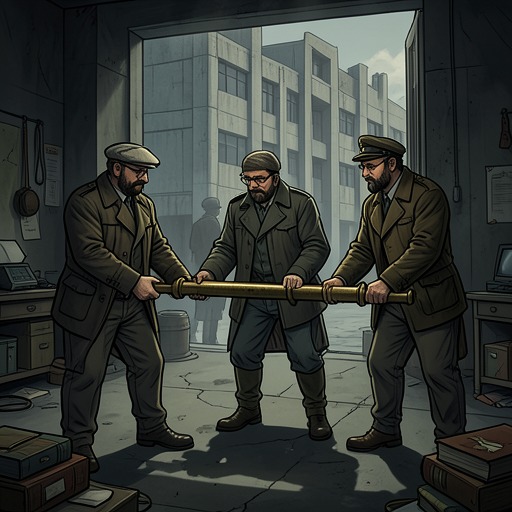
That capacity suggests an experiment in fabricating occult history. Casaubon proposes feeding Abulafia a few dozen propositions drawn from the Diabolicals, together with connective phrases such as “It’s obvious that” and “This proves that.” The resulting text could be made to look revelatory by filling its gaps and treating its repetitions as prophecies. Belbo welcomes the proposal; the work begins with papers selected at random, and Gudrun’s disorderly gathering of pages becomes, in effect, a human version of the machine’s randomization. The next morning Belbo is radiant and announces that the method works beyond their hopes. The Plan’s central technique is therefore demonstrated not as the discovery of a hidden historical order, but as the construction of persuasive connections from fragments.
The joke becomes especially pointed when Diotallevi asks whether Abulafia could be given the whole Torah to perform temurah, recombining its verses. Belbo agrees in principle, while observing that the operation would take centuries. The same combinatorial logic that can rearrange poetry can be imagined as a way to search sacred texts or assemble a map of secret history. Yet the gap between a theoretical space of possible combinations and the labor required to locate a meaningful result remains enormous. The machine makes the method imaginable without proving that any particular outcome is true.
From electronic memory to a fictional self
Belbo’s private files preserve more than technical experiments. Casaubon later realizes that while Belbo reported only the bare outline of his findings about the Rosicrucian period, he was composing a much richer narrative inside Abulafia. There, quotations and fragments of historical writing mingled with his private myths. The chance to combine other people’s stories had prompted him to attempt a story of his own. Casaubon reads this, cautiously, as Belbo testing his talent in fiction—or defining himself inside the Great Story he was distorting like one of the Diabolicals.
As the Plan’s falsehoods press in, the distinction between fiction and life becomes a matter of survival. Diotallevi gives Belbo a warning about identifying himself with the Plan: such identification can become evil. Belbo responds, at least in part, by writing the Plan down word for word as if it were Colonel Ardenti’s memoirs. Casaubon believes this act of narration may have been a cure: by turning the Plan back into literature, however second-rate, Belbo could return it to the realm of what was not life. Abulafia enables that movement because the machine is at once archive and writing surface, preserving the invented system while allowing Belbo to recast it as a text.
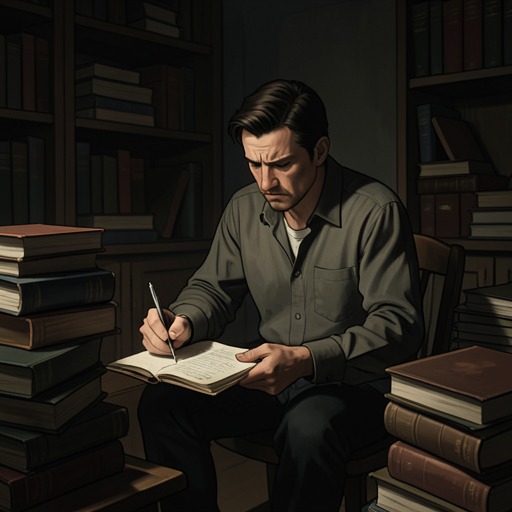
The files also let Casaubon assemble the account of Belbo’s last days. Their final conversation with Diotallevi survives in a feverish Abulafia record whose language Casaubon cannot confidently divide between the two men. Belbo later remains shut up in his apartment for four days, reviewing his files sentence by sentence and writing what Casaubon understands as a final testament—to himself, the machine, Casaubon, or anyone able to read it. Abulafia is not a transparent witness: its contents require interpretation, and Casaubon reconstructs rather than simply retrieves the past. Still, it provides the record through which Belbo’s final attempt to reject the Plan becomes legible.
Combinatorics, power, and limits
The novel extends Abulafia’s logic beyond Belbo’s personal use. Diotallevi imagines the Jesuits collecting information and assembling it through an ars combinatoria, anticipating electronic computers. He distinguishes the abstract model of all possible combinations from a machine capable of carrying them out. Kircher and Schott are associated with mechanical devices using perforated cards and binary calculation: computers before the computer, combining cabalistic permutation with technology. Abulafia thus belongs to a longer imagined history in which the impulse to organize every fragment and compute every possible relation precedes modern electronics.
That history also sharpens the danger of the device’s promise. Random arrangements can generate lines that sound meaningful; a sufficiently eager interpreter can supply connections and call them prophecy. The Plan exploits precisely this movement from possibility to apparent proof. Abulafia gives the process an objective, mechanical appearance, but the machine’s obedience cannot certify the truth of what its users feed it or infer from its output. It can preserve Belbo’s words, rearrange fragments, and erase a line; it cannot decide whether a pattern is historical evidence or a story made to satisfy the hunger for one.
Its final significance is therefore double. Abulafia helps Casaubon recover Belbo’s private voice, including the evidence of his fear, invention, and attempted return to literature. At the same time, it embodies the seductive fantasy that enough stored information and enough combinations will disclose a secret beneath the world. The archive makes the Plan’s construction visible, but its most consequential lesson is that a machine’s memory and combinatorial power do not turn interpretation into truth.